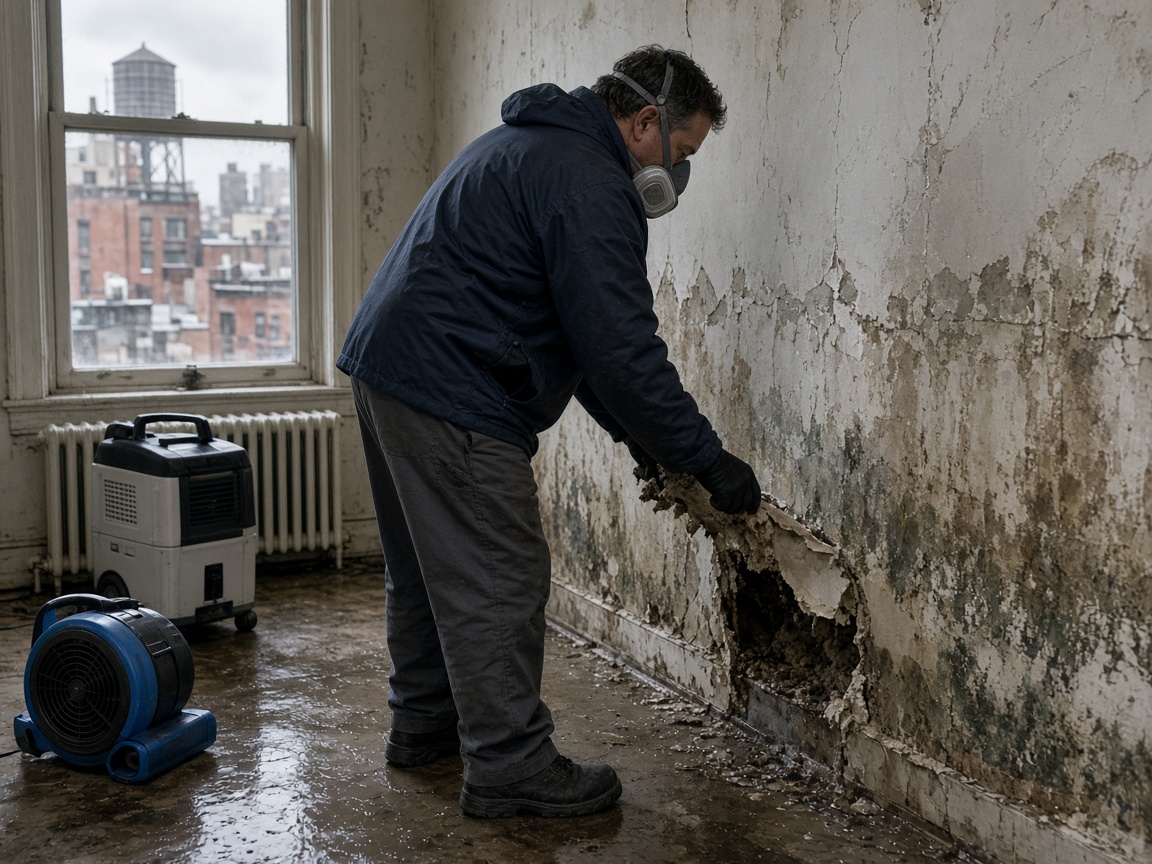
Older brick and brownstone buildings common in Manhattan and the Upper East Side often hide water behind thick plaster walls and under wide-plank floors, allowing moisture to travel unseen to adjacent units. In New York County’s dense row-house stock, a single roof leak near Central Park can affect multiple floors before visible signs appear on the ground level. Technicians must map moisture with meters rather than relying on surface inspection alone.
Hot humid summers accelerate mold growth on saturated drywall and insulation, while cold winters bring frozen pipes that burst when temperatures swing, especially in unheated basement spaces common throughout the borough. Restoration crews working near Times Square or the Empire State Building frequently deal with limited access for equipment because of narrow service elevators and strict building rules on noise and debris removal.
After extraction, dehumidifiers must run longer in New York’s humid subtropical climate to reach the 35–40 percent relative humidity needed to protect hardwood floors and prevent warping. Homes in the Bronx and Brooklyn with slab-on-grade construction add another layer because water can wick upward through the concrete, requiring targeted floor drying mats rather than simple air movers.
Technician insight
In New York, the thing that catches most people out with Residential Water Damage Restoration is how quickly moisture travels through the shared walls and floor joists of 100-year-old Manhattan brownstones; a leak on the third floor near Central Park can saturate the first-floor parlor without any visible ceiling stain until the plaster is opened.
Upper East Side brownstone leak
Water from a roof drain line entered a third-floor wall and traveled down two stories inside the plaster. Meters showed elevated readings in the parlor floor joists even though only minor discoloration appeared on the ceiling. Crews opened limited sections, extracted water, and ran drying equipment for six days until readings returned to normal, allowing the owner to avoid full floor replacement.
Residential Water Damage Restoration Services We Offer
✓Burst Pipe Restoration
Locate and isolate leaks in older galvanized or cast-iron lines typical of Manhattan brownstones, then remove affected plaster and flooring before drying concealed cavities.
✓Storm Flood Cleanup
Extract standing water from basement apartments after heavy summer rains or coastal storms that push water from the East River into low-lying blocks near Brooklyn and the Bronx.
✓Sewage Backup Remediation
Remove contaminated water from combined sewer overflows common in New York County during intense downpours and disinfect subfloor areas in pre-war buildings.
✓Ceiling and Wall Drying
Cut and dry wet plaster and lath in Upper East Side apartments where water travels downward from roof leaks or overflowing roof drains on tall structures.
✓Hardwood Floor Restoration
Lift and dry cupped or buckled floors in historic homes near Central Park, then reinstall or replace boards once moisture readings stabilize.
Residential Water Damage Restoration Cost in New York, NY
| Service | Typical Range | What Affects It |
|---|---|---|
| Initial inspection and moisture mapping | Free–$150 | Waived when restoration work proceeds |
| Water extraction and basic drying setup | $800–$2,200 | Varies with number of rooms and floor levels |
| Extended drying and monitoring | $400–$900 | Per additional week in humid summer conditions |
| Plaster wall and ceiling repair after drying | $1,200–$3,500 | Higher in pre-war Upper East Side buildings with ornate finishes |
Ranges are typical for New York, NY and confirmed with an exact written quote before any work starts.
How it works
- 1
On-Site Assessment
Technicians arrive within hours, document moisture levels with meters, and identify the water source in the specific building type found in Manhattan or the Upper East Side.
- 2
Water Extraction
Remove standing water using portable pumps suited for narrow stairwells and service elevators common in New York County pre-war buildings.
- 3
Structural Drying
Set up air movers and dehumidifiers calibrated for the area’s humid summers, monitoring progress daily until drywall and subfloors reach safe moisture content.
- 4
Sanitizing And Restoration
Apply antimicrobial treatments where needed, then reinstall or replace finishes to match original materials while complying with local building access rules.
Pricing
Most residential jobs begin with an upfront assessment; final cost depends on square footage affected, depth of hidden moisture, and building access constraints.