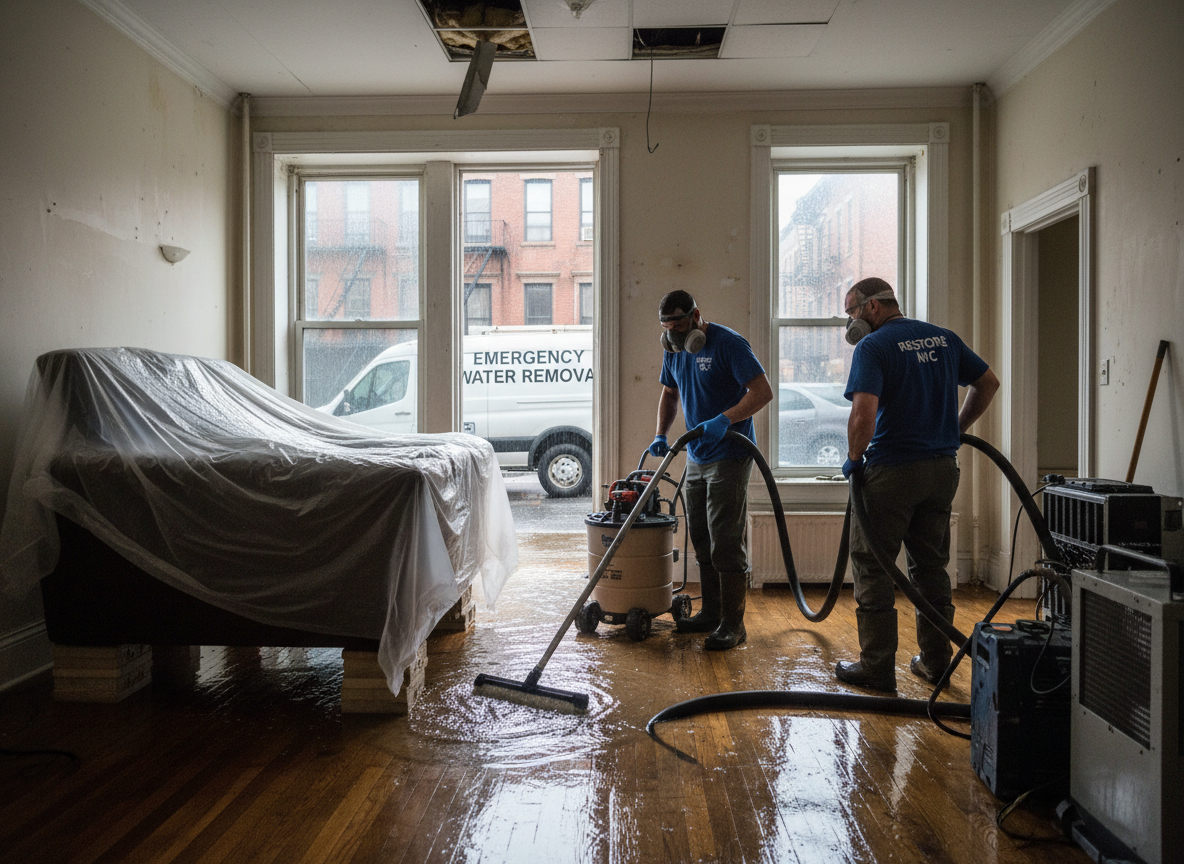
New York County buildings, especially those in Manhattan and the Upper East Side, often date to the early 1900s with plaster-over-lath walls and cast-iron plumbing that corrodes from decades of humid subtropical summers. When a leak starts, water travels along joists and behind brick facades, reaching units on multiple floors before residents notice. Technicians must map moisture with meters rather than relying on visible stains, then open walls in controlled sections to avoid disturbing neighbors in tight row-house layouts.
Winter cold snaps in New York County freeze supply lines in unheated basements and crawl spaces common under brownstones near Central Park. Once temperatures rise, the sudden thaw sends water into finished lower levels where electrical panels sit close to slab floors. Extraction crews stage pumps on sidewalks because interior access is narrow, and they route dehumidifiers through windows to keep drying equipment from overheating apartments during humid summer follow-up visits.
Storm runoff from Times Square and surrounding high-rises funnels into combined sewers that back up into Bronx and Brooklyn basements during heavy summer rains. Restoration teams use air movers angled at 45 degrees along brick foundations to push moisture out before it reaches joist ends, and they document every step for insurance adjusters who require photos of removed baseboards and subfloor cuts.
Technician insight
In New York, the thing that catches most people out with Emergency Water Damage Restoration is how quickly moisture travels through the horsehair plaster and brick party walls of Upper East Side row houses; once it crosses into the neighboring unit, the job doubles in scope and you have to coordinate with two sets of owners before drying can finish.
Frozen Pipe in Upper East Side Brownstone
A cold snap burst a supply line in the basement of a 1920s building near Central Park. Water reached the first-floor parlor and the neighbor’s unit through shared joists. Crews extracted water the same afternoon, opened baseboards on both sides, and ran drying equipment for four days until readings stabilized.
Emergency Water Damage Restoration Services We Offer
✓Burst Pipe Water Extraction
Rapid removal of standing water from cast-iron line failures common in pre-war Manhattan apartments before moisture reaches neighboring units.
✓Basement Flood Cleanup
Pumping and drying of lower levels in Upper East Side brownstones where combined sewers back up after summer storms.
✓Winter Freeze Damage Restoration
Thaw response and drying for pipes that rupture when temperatures swing from cold nights to warmer days in New York County buildings.
✓Mold Prevention After Leaks
Targeted drying and material removal in humid conditions to stop growth behind plaster walls before it spreads through row-house framing.
✓High-Rise Water Intrusion Repair
Floor-by-floor moisture mapping and extraction in buildings near Times Square and the Empire State Building where leaks travel vertically through chases.
Emergency Water Damage Restoration Cost in New York, NY
| Service | Typical Range | What Affects It |
|---|---|---|
| Initial Assessment and Moisture Mapping | $150–$350 | Higher when multiple units or floors must be checked |
| Water Extraction | $400–$900 | Depends on volume and whether pumps must be staged on sidewalks |
| Drying Equipment Rental per Day | $200–$450 | Varies with summer humidity or winter cold slowing evaporation |
| Material Removal and Disposal | $300–$700 | Increases with plaster walls and tight stair access in pre-war structures |
Ranges are typical for New York, NY and confirmed with an exact written quote before any work starts.
How it works
- 1
On-Site Assessment
Technician arrives within hours, uses moisture meters on walls and floors, and notes building age and access constraints in Manhattan row houses.
- 2
Water Removal
Pumps and extractors clear standing water while protecting adjacent units in tight Upper East Side layouts.
- 3
Drying and Monitoring
Industrial dehumidifiers and air movers run until readings drop, with daily checks to adjust for summer humidity or winter cold.
- 4
Material Removal and Containment
Cut out saturated plaster or subfloor sections, bag debris, and seal work areas to limit dust in occupied buildings.
- 5
Final Verification
Return with meters to confirm dryness before any reconstruction begins.
Pricing
Upfront quotes after inspection reflect access difficulty in older Manhattan buildings and the number of floors involved.